
The Role of BPC‑157 in In‑Vitro Angiogenesis and Vascular Signaling Research
What Is BPC‑157?
BPC‑157 (Body Protection Compound‑157) is a synthetic pentadecapeptide (15 amino acids) derived from a larger protein found in gastric juice. In research settings, it is frequently classified as a cytoprotective peptide and is widely used in studies involving:
- Angiogenesis (formation of new blood vessels)
- Endothelial cell function
- Vascular signaling pathways
- Gastrointestinal and vascular integrity models
Because BPC‑157 is highly stable in solution compared with many other short peptides, it is considered a useful tool compound for in‑vitro and in‑vivo experimental designs.
External reference: Overview of BPC‑157 and its experimental applications can be found in peer‑reviewed summaries such as PubMed Central by searching “BPC‑157 angiogenesis” and related terms.
Angiogenesis: Why It Matters in Research 
Angiogenesis is the process by which new blood vessels form from pre‑existing vasculature. It is a central topic in:
- Vascular biology
- Tissue engineering
- Regenerative medicine
- Oncology research
- Ischemia and perfusion models
In many experimental setups, endothelial cells (e.g., HUVECs – human umbilical vein endothelial cells) are used to evaluate:
- Tube formation on Matrigel or similar substrates
- Migration assays (scratch/wound models, Boyden chamber)
- Proliferation assays
- Expression of angiogenesis‑related markers (e.g., VEGF, VEGFR2, eNOS)
BPC‑157 is often introduced into these models as a test peptide to study how it may influence endothelial behavior, signaling cascades, and vascular network formation under controlled laboratory conditions.
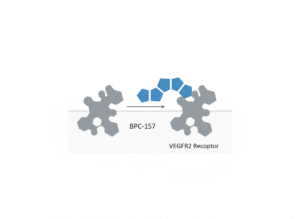
BPC‑157 and VEGF / VEGFR2‑Related Pathways
One of the most cited areas of interest around BPC‑157 is its relationship with VEGF (Vascular Endothelial Growth Factor) and its receptors, especially VEGFR2 (KDR/Flk‑1).
In various experimental models, researchers have observed that BPC‑157 may:
- Modulate VEGF signaling
- Influence VEGFR2 expression or activation
- Support endothelial cell organization into capillary‑like structures in in‑vitro angiogenesis assays
These observations are usually assessed by:
- Western blot for VEGF/VEGFR2 and downstream molecules
- Immunohistochemistry or immunofluorescence
- Real‑time PCR for VEGF pathway transcripts
For a broader background on VEGF/VEGFR2 signaling in angiogenesis, see standard reviews such as ScienceDirect topic pages on VEGF signaling and related vascular biology articles.
Important: Syntech Peptides does not claim any medical, therapeutic, or clinical effects for BPC‑157. All references are to preclinical and experimental contexts only.
Nitric Oxide (NO) and Endothelial Function
Another recurrent research theme is the interaction between BPC‑157 and Nitric Oxide (NO) pathways:
- eNOS (endothelial Nitric Oxide Synthase) produces NO in endothelial cells.
- NO regulates vascular tone, perfusion, and endothelial homeostasis in experimental systems.
In preclinical studies, BPC‑157 has been investigated for potential effects on:
- eNOS expression or phosphorylation status
- NO production in endothelial cultures
- Balance between pro‑angiogenic and anti‑angiogenic conditions
These endpoints are typically measured via:
- NO assays (e.g., Griess reagent or fluorescent NO probes)
- Western blot for eNOS and phospho‑eNOS
- Functional assays (vasodilation models in isolated vessel preparations)
For more on NO and vascular research, researchers often consult broad vascular biology overviews such as those indexed in PubMed.
Syntech Peptides BPC‑157 Products (Research Use Only)
Syntech Peptides offers BPC‑157 in research‑grade formats suitable for in‑vitro and in‑vivo experimental protocols, subject to local regulations.
Key technical points:
- Purity: ≥ 98% (HPLC‑verified)
- Form: Lyophilized (freeze‑dried) powder for improved stability
- Intended Use:
- Laboratory research
- Assay development
- Method validation
- Not for human consumption, medical, veterinary, or diagnostic use
Each batch is accompanied by:
- Certificate of Analysis (CoA)
- HPLC chromatogram
- Mass spectrometry confirmation of molecular weight
This allows researchers to precisely document the peptide characteristics in their experimental methods sections.
Reconstitution, Handling, and Storage (Technical Guidance)
Correct handling of BPC‑157 is critical for consistent experimental results:
Reconstitution
- Use Bacteriostatic Water or sterile 0.9% saline, depending on your protocol.
- Typical research practice is to prepare a stock solution (e.g., 1–2 mg/mL), then dilute into buffer or media for working concentrations.
- To maintain peptide integrity, avoid repeated freeze‑thaw cycles:
- Aliquot the stock solution into smaller volumes.
Storage
- Lyophilized powder: Store at −20°C or below, protected from light and moisture.
- Reconstituted solution: Store at 2–8°C for short‑term use as per internal lab SOPs; for longer storage, −20°C is commonly used.
Always follow your institution’s internal SOPs, risk assessments, and any applicable regulations when working with peptide compounds.
Typical Research Applications for BPC‑157
While designs vary by lab, BPC‑157 is commonly used in:
-
In‑vitro angiogenesis assays
- Tube formation on Matrigel or collagen
- Quantifying branch points, total tube length, and network complexity
-
Endothelial migration models
- Scratch assays on endothelial monolayers
- Chemotaxis models assessing directed migration
-
Vascular protection models
- Co‑treatment with stressors (e.g., oxidative stress, cytokines) to assess cytoprotective potential
- Evaluation via cell viability assays (MTT, WST‑1, etc.)
-
Signaling pathway analysis
- Phosphorylation of key signaling proteins (e.g., Akt, ERK, eNOS)
- Cross‑talk between VEGF, NO, and other angiogenic regulators
For literature context, searching “BPC‑157 angiogenesis,” “BPC‑157 VEGFR2,” or “BPC‑157 endothelial cells” in PubMed or PMC will surface relevant experimental papers and reviews.
Compliance Statement
Syntech Peptides supplies BPC‑157 strictly as a research chemical:
- Not for human consumption
- Not for therapeutic, diagnostic, or veterinary use
- Intended only for qualified laboratories and trained professionals
All discussions above refer exclusively to preclinical research and should not be interpreted as medical advice or product claims.