
 The Biochemistry of Growth Hormone Secretagogues: A Structural and Functional Analysis
In the field of molecular endocrinology, Growth Hormone Secretagogues (GHS) are defined as a diverse class of synthetic compounds that act as potent agonists of the Growth Hormone Secretagogue Receptor (GHSR-1a). Unlike Growth Hormone Releasing Hormone (GHRH), which follows a different signaling pathway, GHS molecules mimic the action of the endogenous ligand, Ghrelin.
For researchers, understanding the minute structural differences between these compounds is essential for predicting receptor affinity, half-life, and secondary signaling effects in laboratory models.
1. The Molecular Architecture of the GHSR-1a Receptor
The GHSR-1a is a G-protein-coupled receptor (GPCR) characterized by seven transmembrane domains. Research published in Nature and PMC indicates that the binding pocket for GHS molecules is located deep within the transmembrane bundle.
The stability of the “active” state of this receptor depends on specific electrostatic interactions, particularly at the Glu124 residue. Synthetic peptides are engineered to optimize these interactions, often by substituting natural L-amino acids with D-isomers to resist enzymatic degradation.
2. Comparative Breakdown of Research Compounds
To select the appropriate compound for a study, one must analyze the specific peptide sequences and molecular weights that define their stability.
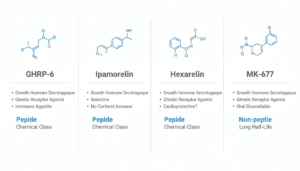
GHRP-6 (Growth Hormone Releasing Peptide-6)
- Molecular Formula: C46H56N12O6C_{46}H_{56}N_{12}O_{6}
- Sequence: His-D-Trp-Ala-Trp-D-Phe-Lys-NH2
- Technical Profile: GHRP-6 was one of the first hexapeptides developed in this class. Its structure includes a D-Tryptophan residue, which is a critical modification that prevents rapid breakdown by dipeptidyl peptidase-4 (DPP-4). In in-vitro settings, it is frequently used to study the activation of the phospholipase C (PLC) signaling pathway.
Ipamorelin
- Molecular Formula: C38H49N9O5C_{38}H_{49}N_{9}O_{5}
- Sequence: Aib-His-D-2-Nal-D-Phe-Lys-NH2
- Technical Profile: Ipamorelin is often cited in literature as the most “selective” GHS. Structurally, it lacks the N-terminal amino acids that typically trigger the release of ACTH or Cortisol in certain models. This makes it a “clean” agonist for researchers who require a narrow focus on GHSR-1a activation without cross-reactivity.
3. Structure-Activity Relationship (SAR) in Peptide Synthesis
The efficacy of a GHS compound is determined by its Structure-Activity Relationship. By modifying the C-terminus (often through amidation) or the N-terminus, chemists can alter how the molecule fits into the GHSR-1a “pocket.”
For instance, the inclusion of D-2-Naphthylalanine (D-2-Nal) in Ipamorelin’s sequence provides a bulky hydrophobic group that enhances binding stability compared to the simpler structures found in earlier generations of secretagogues.
4. Laboratory Standards and Reconstitution
For valid experimental results, the purity of the compound is paramount. Syntech Peptides ensures that all GHS compounds undergo High-Performance Liquid Chromatography (HPLC) and Mass Spectrometry (MS) to verify molecular weight and sequence accuracy.
Researchers should note that these lyophilized (freeze-dried) powders are highly sensitive to temperature and pH. Reconstitution should typically be performed with Bacteriostatic Water or sterile saline, depending on the specific requirements of the assay.